Showing posts with label Unicef. Show all posts

Friday, December 28, 2012

Child Trafficking is Happening in Your Neighborhood

Hi everybody,

I was recently invited to attend a UNICEF speakers event focusing on child trafficking and the atrocious ways adults often abuse children. 
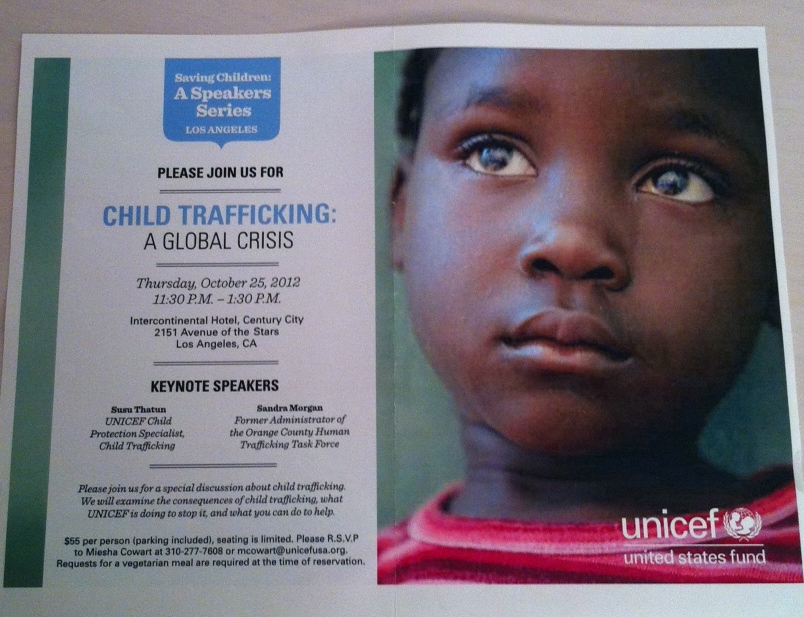


The invitation I recieved for this educational outing.

Child trafficking happens all over the world, it might even be happening in your own neighborhood. Dr. Susu Thatun, a chid protection specialist, spoke about trafficking and migration with regards to her work with UNICEF. 


Me with Dr. Susu Thatun ~  s

What exactly is child trafficking and why is it happening so close to you? 

The US is considered one of the major destinations for trafficked victims. Anyone can be traficked regardless of gender, citizenship, education, class, and age. 

A map of America, and it's trafficking levels.


Child trafficking has been compared to modern-day slavery that subjects children, women, and men to force, fraud, or oppress for the purpose of exploitation. 

Sad Fact:  More than 1.2 million children are trafficked around the world every year, and this number is increasing. 


Trafficked children can be forced into three main industries including, sexual trafficking,  labor trafficking, and domestic servitude.

Sexual trafficking includes prostitution, pornography and sex tourism. Sexual trafficking occurs in everyday places such as nail salons, truck stops, massage parlors, and online solicitation where children are forced to sell their bodies to strangers.


Sadly, most women and children trafficked are uneductated, poor, and live their lives vulnerable to men. 

They are often sold by their families then brought and held captive in America. 


Some slaves are forced to work in factories making tennis shoes and other every-day items we use. 

Nike has allegedly used child labor for years.


Child slave labor produces many products we currently use, such as gold, sugarcane, coal, cotton, rice, tobacco, cacao, diamonds, garments, bricks and carpets. 

A large amount of exploitive labor is done in agricultural work. 

A young boy in a Bangladesh silver factory, imprisoned where he has no life.


Here's an easy way for you to tell if a company has made a product without child labor.  Find the "Fair Trade" symbol, indicating the item was not made by a child slave.


Fairtrade Labeling Organization International

Another form of slavery is when women and children are sold to be houskeepers without any compensation. This is called domestic slavery.

A ten year old Egyptian girl, Shyima Hall,  was sold by her parents and smuggled to a family in Orange Country. She was forced to live a miserable life as a personal maid, forced to sleep on a bare, dirty mattress in a windowless garage. She lived in squalor, was denied doctor appointments, kept out of school and the family called her "stupid girl". 

Shyima was rescued after a tip from a neighbor. She has since gone on to college and has become an American citizen. 


Shyima Hall telling her story as a domestic slave, and the family she was forced to care for. 

Supply and Demand

As long as there are bad people willing to buy children there will be bad people willing to sell them. 

We need to be aware of the products we buy. 

We need to prosecute traffickers. 

And we need to support organizations who fight for the children.

Here's a link to my fundraising page for UNICEF. Please consider donating to end child trafficking. 


http://inside.unicefusa.org/goto/emanzadventures

Thanks, 

Emmanuel 

Monday, July 30, 2012

Hura's History


Hi everybody,

Today, I'm interviewing one of my favorite teachers who has inspired me to love history.

Ms. Hura, one of JTD's finest, is always positive, energetic and even humorous.  She truly makes history fun to learn.


Ms. Hura,  always with a bright smile. 


Ms. Hura's love for history has sparked my own passion for the subject.


My 5th grade history text book.


I love studying Napoleon, European history, American history, wars, ancient history and the list goes on. I’m fascinated how everything happening in our world today relates back to earlier history. 

For instance, China was a major exporter and trader of silk and spices in the 14th and 15th centuries. Once again, China is now a major exporter of manufactured goods.  


Ancient Chinese Trading Ship


Modern day Chinese Trading Ships


I was curious to learn where her passion for history began...


EZ- What sparked your passion for history? 

DH - My dad was a huge history buff and has worked for the government and a few presidents in the past. The stories he would tell always intrigued me and got me loving history. History is a true story….what's not to love about true stories right?


EZ- What's your trick in motivating your students to love history? 

DH- I think I have an understanding about being a student…I always wished my teachers had made us laugh more, or would goof off themselves. Sitting in class for a double period can be long and uninspiring. Knowing that, I try to mix things up a bit, make you guys laugh, give you something else to think about, rather than just listening to my voice all period long! Plus, being a huge fan of the subjects I get to teach you guys, keeps me peppy and wanting you guys to try to love the subjects as much as I do! 

An inspiring teacher, "Dead Poets Society"


EZ- What's your favorite period in history? 

DH- My favorite period of history is the US from the early 1950s to the end of the 1960s. (post-WW2) Our country was reinventing itself all on its own and the famous characters of the time inspire me and keep me wanting to learn more and more! 


EZ- What piece of advice would you give me (and my fellow classmates) to prepare for 6th grade? 

DH- I would hope you guys can arrive in fall still confident in your writing skills and note taking skills. These are going to help you so much in 6th grade and for the rest of your academic careers. Also, I hope you all come in positively and embrace the very special year of 6th grade at JTD. You will be busy but with all of the exciting things only 6th graders get to do, I want you all to enjoy each moment!! 


EZ-Why is history important for us all?

DH- History is important to us all because it is proof that mistakes can happen. Bad decisions have occurred even in the White House. History teaches us to accept responsibility and learn from our mistakes. We all make them, but studying how others lived through their own mistakes and fixed things, might help us grow as citizens and citizens who aim to do the right thing whenever possible.


DH-...You and your UNICEF charities are making history Eman! You are teaching others how to be a good citizen and hopefully people are reading about you and learning from you right as we speak!


Thanks, Ms. Hura for your time.
I hope you all enjoyed meeting one of my favorite teachers.

Thanks

Emmanuel


Sunday, May 13, 2012

Hookie Day with Ishmael Beah


Last week, I was given two great privileges in one day. One, I got to hear Ishmael Beah speak and two, I was allowed to miss school for the opportunity. Woo Hoo! 


Who is Ishmael Beah, you ask?

Let me tell you his story and why I believe it’s important for you to know what happened to him. 

Ishmael Beah is a former child soldier from Sierra Leone who wrote an autobiography about his life in war and how he escaped.

http://www.amazon.com/Long-Way-Gone-Memoirs-Soldier/dp/0374531269/ref=sr_1_1?s=books&ie=UTF8&qid=1336956871&sr=1-1
            Ishmael Beah was just an ordinary child in the country of Sierra Leone. Sierra Leone is located in West Africa, south of Senegal. Ishmael had a regular life with friends, family, school (he even learned some Shakespeare), and he loved American hip-hop. Ishmael even said "My life before the war was very simple but very happy, very peaceful, beautiful, and the people were incredibly kind and nice. I didn't fear anything, anything, nothing at all".


West Africa; Senegal (where I visited last Summer) is North of Sierra Leone


            When Ishmael was just twelve years old, the civil war was brought to the small town in which he lived. Both of his parents were killed as well as his only two brothers. He escaped with a group of boys, forced to survive and hide from the rebels in the country. When Ishmael and his young friends went to seek help in neighboring villages, people didn’t want to help them because children were not trusted; children could be brutal soldiers.  


A Child Soldier


Adults no longer saw these young children as innocent little faces, but monsters hired by the government to kill. Looking for shelter and protection, Ishmael found and army base.  Once there, he was forced to fight for the government against the rebels in return for food and safety.


            The army used drugs to brainwash these children so they would follow orders to kill. The drugs fueled the children’s rage and hatred against the rebels who murdered their families, and gave them energy to keep fighting. The commanders of the army became father figures to the children who had lost everything.

Courageous field workers from UNICEF risked their lives to negotiate with the warlords and request children be freed. Sometimes the commanders would comply, BUT only to boys, girls were kept for sexual exploitation, and to help cook and clean.

Former Child Soldier studying at a UNICEF Relief Camp


            Ishmael was freed by UNICEF at fifteen years old. He went through 8 months of rehabilitation, psychotherapy and schooling. When he was sixteen he was lucky enough to travel to NY to speak at the UN about child soldiers. There, he met a woman who eventually became his “new mother” and he ended up fleeing Sierra Leone and moving in with her.


Laura Simms, Beah's Adopted Mother


I’m telling this story because I think people should pay more attention to the problem of child soldiers in the world. Hundreds of thousands of child soldiers exist around the world today and we can help make a difference. The children of the world are the future leaders and citizens of tomorrow. Please share this story and support organizations, like Ishmaels, who are helping children in war torn countries. : http://www.beahfound.org/Beah_Foundation/Donate.html )
or


Ishmael Beah and I


If you have any questions, ask me in the comments area and I will get back to you as soon as I can. 
And, If you would like a chance to win a signed copy of Ishmael's memoirs, leave a comment about this post and I will randomly choose one lucky winner by Friday May 18th.


Thanks everyone.
Emmanuel